The Sacred Pause. Where do you find it?

The Sacred Pause… where do you find it?

As yoga practitioners, we often explore the value of slowing down. One concept that has gained particular attention in mindfulness-based approaches is the Sacred Pause. On the yoga mat we can  come to appreciate how powerful this simple moment of stopping can be - now more than ever in a world that rarely gives us permission to pause. On the yoga mat we are supported in getting curious about where we might find this, sometimes elusive, sacred pause. In moments of stillness, in moments on the move, in moments off the mat as we live our life. Conscious-awareness moments, zoning-out moments, difficult moments, moments when we are thrown into absolute turmoil… where do we find the pause?

The Sacred Pause is exactly what it sounds like: a brief, intentional moment of stopping before reacting. In mindfulness practice, this pause allows us to notice what is happening in our body, thoughts, and emotions before we spontaneously react. It’s not about becoming passive or disengaged. Rather, it creates a small space where awareness can enter the picture, from where we can respond more thoughtfully. From a nervous system perspective, this pause can help shift us away from automatic survival responses and toward more regulated, thoughtful action. In your brain, your alarm system is quietening down and your CEO is waking up. Already, even in that one brief pause, our heart beat slows down a little. 

From a Buddhist perspective, the Sacred Pause echoes the practice of mindful awareness taught in the tradition of meditation. In Buddhism, moments of stopping are sometimes described as returning to the breath or coming back to the present moment. Teachers such as Thich Nhat Hanh often spoke about the importance of “stopping” as the first step of mindfulness - pausing long enough to truly see what is happening inside and around us. In that pause, we create space between impulse and reaction, allowing wisdom and compassion to guide our response, rather than habit or reactivity.

Many other cultures and spiritual traditions recognize the value of this kind of pause as well. Moments of silence and stillness can be seen across traditions, religions and cultures over the ages, the idea appears again and again: when we slow down and allow a moment of stillness, we reconnect with something steadier and wiser within us. Whether understood spiritually, culturally, or simply through the lens of nervous system regulation, the Sacred Pause reminds us that stillness itself can be a powerful teacher.

At the moment, many of us are living with a persistent background tension, perhaps subtle at times. Ongoing war and global instability can keep the nervous system slightly on edge, even when we are physically safe. Our biology doesn’t always distinguish well between immediate threat and distant uncertainty. As a result, many people are living in a mild state of fight, flight, or freeze (FFF)—feeling more reactive, distracted, or fatigued than usual. The Sacred Pause offers a gentle way to explore that. Even a few conscious breaths can signal to the body that it’s safe enough to soften.

In contemplative practices including yoga and mindfulness we often speak about responding rather than reacting. The pause is the doorway to that possibility. When we pause, we might notice the breath moving, give space to the shoulders softening or the jaw unclenching. These small shifts activate the parasympathetic nervous system—the body’s natural settling response. Over time, practicing this again and again helps build our capacity for regulation and resilience.

On the yoga mat, the Sacred Pause can show up in many ways: the moment before moving into the next pose, the moment at the top of an inhale, or the stillness in the space after an exhale. It’s also a beautiful place to set an intention. Rather than rushing from one shape to another, we can use these pauses to ask ourselves: How do I want to meet this moment? With curiosity? With kindness? With patience? With strength? We can use these pauses to explore wise action.

Over the coming classes, we’ll begin to explore the Sacred Pause more deliberately in our breath-work, in our physical practice and in our moments of meditation and relaxation. Settling into feeling how these small moments of stillness can support both our bodies and our nervous systems, our thinking patterns and our curious, noisy minds. Sometimes the most meaningful part of practice isn’t the movement itself, but the quiet awareness that arises in the spaces in between.

As psychiatrist and Holocaust survivor Viktor Frankl wrote:

“Between stimulus and response there is a space. In that space is our power to choose our response. In our response lies our growth and our freedom.” 

Join us in yoga to explore all of this and more! Thoughtful, fluid movement with ease and grace. Spacious, smooth, slow, deep breathing. A mind that is awake and yet calm regardless of the shape of the body and the patterns of the mind. 

As always, guidance will be for all levels of practice. We'll head off together on a progressive learning journey with each class an independent unit which nods to the overall learning journey. As always, my intention for you is that your nervous system heals for the duration of class and beyond, you move your body in a way that feels wholesome and healthy, you perhaps learn something interesting and, most importantly, you relax and have some fun! 

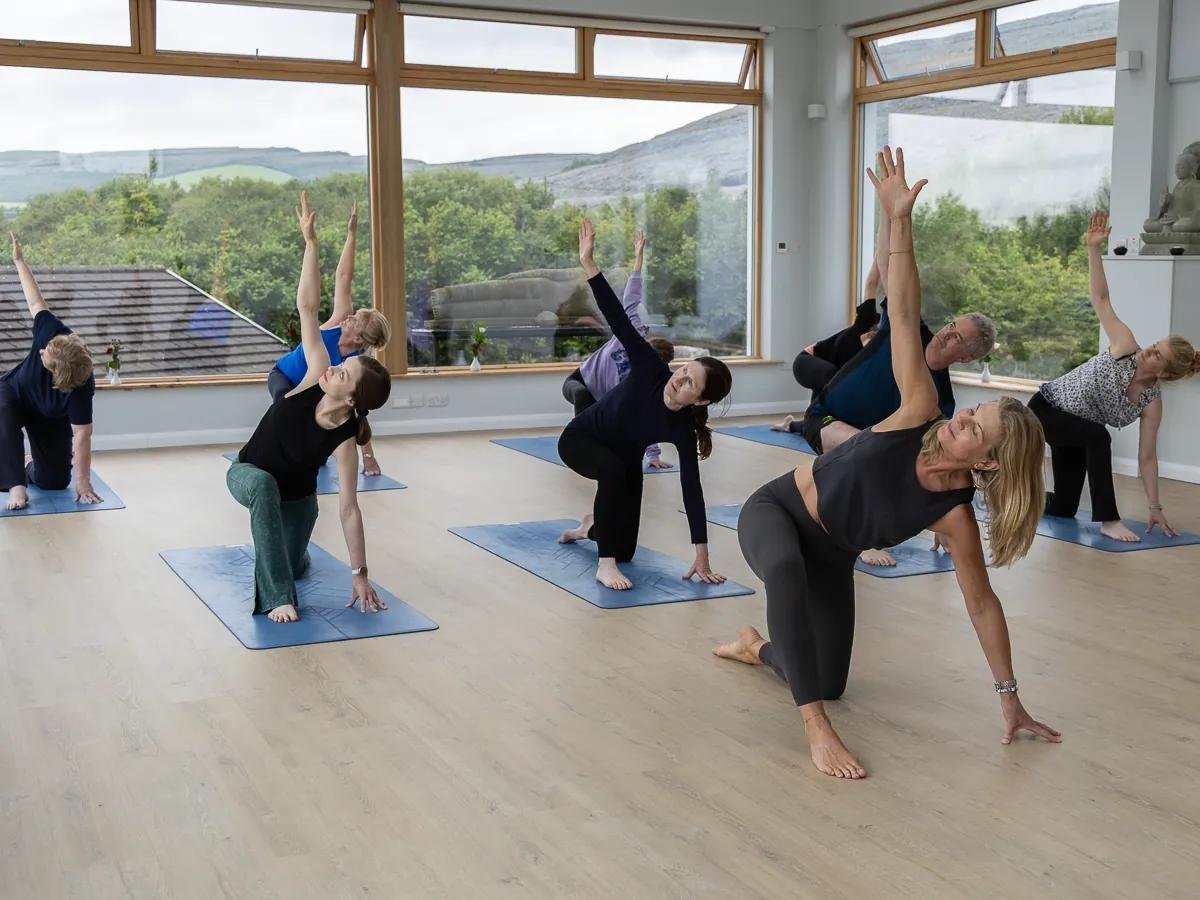
We have spaces in all classes in our warm, bright halls, come to move with ease, to breathe with space, to quieten your nervous system and to train your mind to observe the process. Everyone is welcome.

All classes have spaces. All classes are fully up and running with 17th March, 3rd and 6th April our only upcoming interruptions (Paddy’s Day and Easter Weekend). Join us for a class or a course or a workshop or even a little holiday! More information on everything coming up is here.

Thanks so much for joining me in this fascinating journey called life! Love, Sylvia.

Read More
Core Connection in Yoga: Where Science Meets Subtlety

There’s a moment in practice—perhaps in Plank, perhaps in Warrior II—when something clicks. The feet root, the spine lengthens, the belly subtly tones, and the breath flows steadily. You are strong, but not rigid. Engaged, but not bracing.

That is core connection.

As someone trained in movement science, I love that yoga anticipated much of what modern research now confirms: stability is not stiffness; strength is not strain; and the nervous system thrives on adaptable support rather than forceful control.

The Core in Traditional Hatha Yoga

In classical Hatha Yoga, posture (asana) is described as “sthira sukham asanam” — steady and easeful.

The genius of this instruction lies in its balance.

  • Sthira: grounded, stable, contained

  • Sukha: spacious, relaxed, easeful

The “core” in traditional yoga was never just abdominal strength. It was an integrated center—pelvic floor, lower abdomen, diaphragm, and spine—working together to support a long, graceful axis.

In Tadasana (Mountain Pose), the foundation begins at the feet. The body organizes upward through:

  1. Rooted contact with the earth

  2. Neutral pelvis

  3. Lengthened lumbar spine

  4. Broad ribs

  5. Crown rising

The abdominal wall subtly tones—not gripping—but supporting the natural curves of the spine.

Modern biomechanics would call this balanced co-contraction. Traditional yoga might call it bandha awareness.

What We Now Know About the Core

Contemporary research reframes the core as a dynamic cylinder:

        Diaphragm
           ↓
 Transverse Abdominis
 Internal/External Obliques
           ↓
        Pelvic Floor
           ↓
        Multifidus

This system:

  • Stabilizes the spine

  • Transfers force between upper and lower body

  • Regulates intra-abdominal pressure

  • Interfaces directly with breathing

The deepest abdominal muscle—the transversus abdominis—engages gently in anticipation of movement. This anticipatory stabilization is neurologically driven, not voluntary bracing.

Yoga, when practiced intelligently, refines this timing.

A Long, Graceful Spine: Not a Military Spine

“Sit up straight” is incomplete advice.

A healthy spine is:

  • Curved, not flat

  • Dynamic, not locked

  • Responsive, not rigid

In poses like Plank Pose or Warrior II, we see the modern misunderstanding of the core: students often grip the abdomen and hold their breath.

But breath-holding activates sympathetic tone—the fight-or-flight response.

Instead, when we maintain relaxed diaphragmatic breathing, even while the core is engaged, something remarkable happens:

  • The diaphragm descends.

  • The pelvic floor responds.

  • The abdominal wall tones reflexively.

  • The spine stabilizes without rigidity.

  • The nervous system remains adaptable.

This is evidence-based stability training.

Breath, Core, and the Nervous System

The diaphragm is both a respiratory and postural muscle. It is also deeply connected to the vagus nerve—the primary regulator of parasympathetic tone.

Slow diaphragmatic breathing:

  • Enhances heart rate variability (HRV)

  • Improves vagal tone

  • Reduces excessive sympathetic activation

  • Increases emotional regulation

When we train the core without sacrificing breath, we train nervous system adaptability.

This matters far beyond the mat.

Yoga practice has been shown in neuroimaging studies to:

  • Increase gray matter density in regions associated with self-regulation

  • Improve interoceptive awareness (insula activation)

  • Enhance prefrontal cortex regulation of stress responses

Core connection becomes not just muscular training—but neural integration.

Proprioception, Interoception, and Self-Awareness

In movement science, we distinguish:

  • Proprioception: awareness of joint position and movement

  • Interoception: awareness of internal sensations (breath, heartbeat, tension)

  • Exteroception: awareness of external stimuli

Core engagement in yoga refines all three.

In Warrior II, for example:

  • Proprioception tells you where your pelvis is in space.

  • Interoception tells you if you’re gripping the belly or breathing smoothly.

  • Exteroception tells you how your feet meet the ground.

When the core connects to breath and spine, awareness deepens.

Psychologically, this builds:

  • Emotional regulation

  • Stress resilience

  • Attentional control

  • Embodied self-awareness

Yoga becomes applied neuroscience.

Balanced Action: Stability Without Rigidity

Modern rehabilitation science increasingly emphasizes “optimal stiffness” — enough support to protect joints, not so much that movement becomes inefficient.

Traditional yoga expressed this beautifully:

“Root to rise.”

When the feet ground, the spine lengthens.
When the spine lengthens, the abdomen organizes.
When the abdomen organizes, the breath deepens.
When the breath deepens, the nervous system softens.

Strength and ease co-exist.

Modern Posture and the Sedentary Core

Sedentary life has altered how many people use their core:

  • Over-bracing abdominals

  • Shallow chest breathing

  • Collapsed thoracic spine

  • Weak gluteal support

Yoga retrains:

  • Axial extension

  • Functional abdominal tone

  • Rib mobility

  • Diaphragmatic breath

  • Integrated pelvic control

Rather than isolating muscles, yoga restores relationship.

The Brain-Body Core Connection

The “core” is not just muscular—it is cortical.

Motor control research shows that stability is governed by:

  • Feedforward activation

  • Sensorimotor integration

  • Cortical-subcortical coordination

When we practice sustained postures with breath awareness, we strengthen neural pathways linking:

  • Insula (interoception)

  • Prefrontal cortex (executive control)

  • Cerebellum (movement refinement)

  • Limbic system (emotion regulation)

This explains why core-centered yoga often feels centering emotionally.

It quite literally is.

A Pose Example: Plank Reimagined

Instead of:

  • Grip abs

  • Hold breath

  • Clench jaw

Try:

  • Press through hands and toes

  • Lengthen tailbone to crown

  • Soften ribs

  • Breathe deeply into the back body

The abdominal wall responds naturally.
The diaphragm moves.
The nervous system stays adaptable.

You are strong—but not armored.

Core Connection as a Lifelong Skill

Through this practice we cultivate:

  • Self-awareness

  • Emotional steadiness

  • Adaptability under stress

  • Efficient movement

  • Grounded presence

Psychologically, this becomes resilience.
Neurologically, it becomes regulation.
Physically, it becomes integrated strength.

A Closing Reflection

The core is not a six-pack.
It is not tension.
It is not control.

It is relationship.

Between breath and spine.
Between earth and sky.
Between nervous system and awareness.

In traditional Hatha yoga, steadiness and ease were never opposites.
Modern science agrees.

When we practice core connection with grounded feet, a long graceful spine, subtle abdominal support, and relaxed diaphragmatic breathing, we train far more than muscles.

We train integration.

And integration—of body, breath, brain, and awareness—may be the most enduring strength of all.

Join us all the month on the yoga mat in weekly classes and in events and retreats to explore all this and more.

Read More
Sylvia Ferguson YogaComment
What's the minimum we need to do to maintain the benefits of the 8-week MBSR course?

Dear MBSR friends,

A question asked by a participant as we near the end of our current 8-week Mindfulness Based Stress Reduction Course in Mutton Lane this year… “Sylvia’s what’s the minimum we need to do to keep the benefits we’re feeling now, is yoga once or twice a week enough?”

I loved being asked this question… one of my favourite things about this course is that it is highly researched, ethical and grounded solidly in science. Of course anectodal evidence is great; we loved hearing that a course particpant who did the course three years ago still maintains a daily practice of around ten minutes here and there, plus yoga a few times a week, and it works for her. But what is proven to work when we review large groups of people all across the world? Perhaps it’s more than you might think.

Here comes the science. Below is the evidence, complied with the assistance of AI (with all references double-checked). These are evidence-based, widely accepted recommendations for maintaining home practice after completing an 8-week Mindfulness-Based Stress Reduction (MBSR) program. These suggestions draw from published research on MBSR and related mindfulness-based interventions (MBIs), including work by Jon Kabat-Zinn, the Center for Mindfulness (CFM), and empirical follow-up studies.

1. Recommended Minimum Ongoing Practice

Research on long-term adherence and outcomes consistently shows:

Daily Minimum

  • 20–30 minutes per day of formal practice is the minimum reliably associated with sustained benefits such as reduced stress, enhanced emotion regulation, and improved well-being.

    • Supported by studies showing that post-program practice of ≥20 min/day predicts maintenance of symptom reductions (e.g., Parsons et al., 2017; Goldberg et al., 2018).

Weekly Minimum

  • 3–4 formal practice sessions per week, totaling 90 minutes or more, appears to be the lowest threshold associated with lasting psychological and physiological benefits.

    • Longitudinal analyses of MBSR graduates show that 90–150 min/week of ongoing practice supports maintenance of stress-related improvements (Carmody & Baer, 2008).

Ideal (but not required)

  • The standard MBSR guideline remains 45 minutes daily, 6 days per week—this is the amount used in the original research and teacher training standards.

    • Associated with stronger outcomes and lower relapse into stress reactivity.

2. Recommended Home Practice Options

Participants often benefit from a menu of practices, allowing flexibility while preserving consistency.

Formal Practices

Aim: 20–45 minutes/day

  • Sitting meditation (breath, body sensations, open monitoring)

  • Body scan

  • Mindful yoga (gentle Hatha yoga as taught in the course)

  • Walking meditation

Evidence: These four constitute the core MBSR practices evaluated in RCTs, with body scan and sitting meditation being the strongest predictors of long-term benefit in several follow-up studies.

Informal Practices

Aim: integrate several times per day

  • 3-minute breathing space

  • Mindful eating

  • Mindful walking during daily routines

  • Checking in with bodily sensations before reacting

  • Pausing and labeling emotions (“noting”)

Evidence: Informal mindfulness supports trait-level mindfulness and stress resilience; even short practices (<5 minutes) contribute to maintenance (Shapiro et al., 2006; Creswell, 2017).

3. Structuring a Sustainable Post-Course Practice Plan

Here are design principles drawn from studies on adherence:

A. Set a consistent practice time

  • Morning practice predicts higher adherence (Carmody & Baer, 2008).

B. Use guided recordings at first

  • Enhances adherence and reduces “practice drift.”

C. Alternate practices weekly

Example:

  • Mon/Wed/Fri → Sitting meditation

  • Tue/Thu → Body scan

  • Weekend → Mindful yoga or extended practice (30–45 min)

D. Aim for “minimum effective commitment”

  • If you can maintain 20 minutes/day, long-term outcomes remain strong.

  • If motivation dips: maintain 3–4 sessions/week, minimum 90 minutes total.

4. Maintenance Options After the 8 Weeks

Join ongoing practice groups

  • Community practice significantly increases adherence.

Do periodic “refresher weeks”

  • One week every 2–3 months with 30–45 min/day.

Use mindfulness apps (but selectively)

  • Evidence-supported: Headspace, Calm, Healthy Minds Program, Ten Percent Happier
    Apps improve adherence and benefit maintenance when used 2–3 times/week.

In conclusion let’s recognise there is some amount of effort and discipline required. In the same way we might commit to effort and discipline with exercise, with food, with how we show up for our loved ones. Let’s recognize there is wiggle-room, it’s not one-size-fits-all. The quote by the author Viktor Frankl sums this up nicely,

“Everything can be taken by a man but one thing, the last of the human freedoms. The ability to choose one’s attitude in any given set of circumstances, to choose one’s own way”.

Read More
Sylvia Ferguson YogaComment
Return Policy

If have paid for an event or a class and then cannot attend please let me know as early as you can. I will do my absolute best to refund you or offer you another event or class in lieu. Sometimes this is difficult if it is an event with limited tickets; if it’s very close to the time I may not be able to fill your spot. But I will always do my very best to accommodate you. Thanks for choosing sylvia's yoga, Kindest regards, Sylvia.

Read More
Budget Option Burren Yoga Retreat Centre

Dear yoga friends, 

Great news, we have now have discounted room options on yoga retreats in The Burren Yoga Centre. Our first one upcoming on 3rd-5th October is already fully booked but thereafter from 7th-9th November it will be possible to book a place in a female dormitory with bunk beds

So a weekend will cost €490 for the shared bunk bed female dorm… compared to €700 for an en-suite single bedroom.

 Bank holiday weekends have this room option for €690 for 3 nights

 Week-long retreats €1190

I stayed in one of these room with two bunk beds, four of us, the first time I did a retreat in The Burren Yoga Centre and I loved it. I can’t recommend the whole experience enough. A flavor of the practices we explore is here. Please check their website for more about the amazing food and incredible excursions. 

I’m here for any questions at all and you are always welcome to join us. xxS

Sylvia’s upcoming retreat dates with new budget option shared dorm: 

7th-9th November

27th Feb-1st March

8th-10th May

6-12th June

17-23rd July

Read More
Sylvia Ferguson YogaComment
Step in September ~ book your mat space!

Dear Yoga Friends,

This email details upcoming classes and courses and how you might book in a little time with yourself on your yoga mat.

Community classes continue in Ballyroan Community Centre for morning and day-time classes, in The Park Community Centre for evening. We’ve added a new Friday 2-3pm class to ease us into the weekend with good intentions. All classes tend to be quite busy at this time of year, if you’ve been coming to yoga you’re welcome to just continue as you are and sign up. If you’ve been away for a while please let me know you are coming back (you are always welcome back) and if you are brand new please check with me if there is a space for you.

Morning classes in Ballyroan Community Centre: all classes have a small number of spaces.

Monday 12 noon, Tuesday 10.45am, Thursday 9.30am, Friday 2pm.

Evening classes in The Park Community Centre: Monday class is waitlist, please enquire. Thursday has spaces.

Workshops are back in Mutton Lane Yoga Studio this week! Join us in our beautiful mountain refuge in Tibradden, Wednesday to celebrate the full moon and this coming Saturday morning at 10am for two hours of relaxed yoga, breathwork, meditation, and, as always, a nice relaxation in front of the wood-burning stove.

We have 7 participants signed up for a deep-dive into Mindfulness in Mutton Lane on Wednesday mornings October through November, an 8-week MBSR course. There is just one space left on this course and it’s likely it will run again early in 2026 so please enquire if it sounds interesting.

A variety of weekend and week-long retreats are planned for the Burren Yoga Centre in the West of Ireland. Not just about the yoga, we love the food, the outdoor adventures with a designated guide, and the simple luxuries of the recently refurbished centre as a complete re-set and boost for life. It’s always possible to do part-of the week long retreats so you have loads of options, winter and summer, to contemplate.

Between teaching on retreats and visits to grown-up kiddos living abroad I will be doing some travel in the coming months and have some wonderful substitute teachers ready to cover for classes. So class is always on, even if I’m away, I’m always there myself for the Mutton Lane workshops and for the 8-week course. I’ll continue to manage things in the background so it’s always fine to get in touch, I’ll always do my very best to accommodate whatever is needed for you when life gets unpredictable or your plans change.

Could I ask you please to give me a review on Google? Your 5*s and comments really help.

I’m here for any questions at all and am very excited about the season ahead, really looking forward to seeing you on the mat!

Biggest hugs and love on a chilly, bright, fresh Irish morning,

x Sylvia.

Read More
Keeping things fresh: what's back-to-school like for you?

Like it or not the seasons are changing. The Buddhists claim the one secret to lasting joy is recognizing the inevitable change of everything in life. I always feel the Irish have a small advantage in this regard as our changeable weather can have such a huge impact on our sense of wellbeing. And we’re very good at making hay when the sun shines!

And here it come, Autumn with her slow, dramatic entrance and the back-to-school nip in the air. What’s fresh for you as you contemplate the season ahead? A re-setting of intentions? Something new? A course for your body, or your mind, travel, or simply a new date in your diary to catch up with friends over coffee. All of these things are scientifically proven to be so good for us; life is not just about striving and ticking boxes as we well know, a curious mind, a healthy mobile body and good social connections are the GOLD!

In the yoga community we can explore all of this! I have loads of new, exciting things for you to contemplate as you gently nudge your life, over and over again, in the direction you want it to go… towards a full, rich, well-lived life.

Community classes continue in Ballyroan Community Centre for morning and day-time classes, in The Park Community Centre for evening. We’ve added a new Friday 2-3pm class to ease us into the weekend with good intentions. All classes tend to be quite busy at this time of year, if you’ve been coming to yoga you’re welcome to just continue as you are and sign up. If you’ve been away for a while please let me know you are coming back (you are always welcome back) and if you are brand new please check with me if there is a space for you.

Workshops are back in Mutton Lane Yoga Studio in Tibradden, one evening meditation a month close to the full moon and one Saturday morning workshop each month, two hours of relaxed yoga, breathwork, meditation and always a nice relaxation in front of the wood-burning stove.

We have 7 participants signed up for a deep-dive into Mindfulness in Mutton Lane on Wednesday mornings October through November, an 8-week MBSR course. There is just one space left on this course and it’s likely it will run again early in 2026 so please enquire if it interests you.

A variety of weekend and week-long retreats are planned for the Burren Yoga Centre in the West of Ireland. Not just about the yoga, we love the food, the outdoor adventures with a designated guide, and the simple luxuries of the recently refurbished centre as a complete re-set and boost for life. It’s always possible to do part-of the week long retreats so you have loads of options, winter and summer, to contemplate.

Between teaching on retreats and visits to grown-up kiddos living abroad I will be doing some travel in the coming months and have some wonderful substitute teachers ready to cover for classes. So class is always on, even if I’m away, I’m always there myself for the Mutton Lane workshops and for the 8-week course. I’ll continue to manage things in the background so it’s always fine to get in touch, I’ll always do my very best to accommodate whatever is needed for you when life gets unpredictable or your plans change, and I’ll never out-source to a booking system or to AI or to a chatbot so it’s always Sylvia you’re getting! I don’t filter photos, I’m learning to accept my imperfect self just as I am so I can help you accept your imperfect self just as you are! Change is inevitable, but we can always do our best to keep things fresh, fun and full of adventure.

Intentions for me for the coming year are to dive deep into my own daily practices so I continue to show up to teach with authenticity. I’m upping my game in the gym with a new personal trainer, and I’ve created some exciting new content which will be in the ‘Appendix’ of the new course manual the lucky 8 will be receiving on day one of the new October Course. This content will one day be my book which is slower going than old-Sylvia would have liked but I’m learning to live with that and celebrate the baby steps each time one new page is produced!

Could I ask you all please to give me a review on Google? Your 5*s and comments really, really help and will do so in the future when I write my book and produce online classes to compliment the content. We are all on a shared learning journey as we navigate life together, please don’t ever underestimate how much I learn from all of you and how valuable your presence is in our groups.

I’m here for any questions at all and am very excited about the season ahead, really looking forward to seeing you on the mat!

Biggest hugs and love on a chilly, bright, fresh Irish morning,

x Sylvia.

Read More
Sylvia's retreat dates in The Burren Yoga Centre, 2024 and 2025

Dear Yoga Friends,

I always recommend retreats in the gorgeous Burren Yoga Retreat Centre and many of you tell me it is going on the bucket list! Here we go for upcoming retreats, weekend ones and week-long ones. It’s also fine to do part-of the week long retreats.

Dave is an incredible host and has great attention to detail and to excellence! I’m here for any questions at all about the yoga (I’ll also rant on happily about the food, the comfy beds, the temperature of the Atlantic Ocean…)

I hope to see you there!

Xx Sylvia

Retreat dates:

2025

3rd – 5th Oct

7th – 9th Nov

2026

Feb 27 – Mar 01

May 08 – 10

June 06 – 12

July 17 – 23

Read More
Beginners to Sylvia's weekly yoga classes ~ some helpful information.

Updated August/September 2025

Hi, I’m Sylvia, your yoga teacher. I have been teaching yoga for over 20 years and I am also a Mindfulness Teacher teaching MBSR (Mindfulness Based Stress Reduction) courses. I teach regular weekly yoga classes in Ballyroan Community Centre in the mornings (Monday 12 noon, Tuesday 10.45am, Thursday 9.30am and Friday 2pm) and in The Park Community Centre in the evenings (Monday 7.45pm and Thursday 6.45pm). You can find out information including bookings links and a link to sign up for emails on the events page of my website here.

Classes get very busy in September and again in January and often our classes are full. Those who have been coming regularly get priority on booking spaces but I often have spaces for newcomers and these spaces can come up as we settle back in and plans change for people so please stay in touch with me if you would like to join us, it’s often easiest to send me an email on sylviasyoga.com or a whatsapp on 0876822362.

Yoga courses run in 4-week blocks with the last week of each course focused on an aspect of restorative yoga… Yoga Nidra, Yin or Guided Body Scans. I will ask you to please confirm and pre-pay your next course on the final week of each course. If we have space in the room you are welcome to join us mid-course and if we have space in the room I offer drop-ins.

I will always work with you if you are travelling and need to do part-of a course. I acomodate those who are job sharing, child minding or caring for the elderly so please chat to me if you need flexibility, I will do my best. I do appreciate you letting me know if you can’t make a class but I know life is busy and last minute things crop up. 

Weekly yoga classes are designed to suit everyone. Expect a gentle start in class, combining breath and movement. The physical yoga practice is balanced and healthy; we explore strength, balance, posture, muscle tone, flexibility and range of motion. We delve into breath-work, mindfulness, meditation and guided relaxation practices. All poses are adaptable for beginners. If you have any injuries or medical concerns please check with your doctor before practicing yoga. Please wear loose, comfortable clothing and bring a yoga mat and a small folded blanket if you have one (for padding or for a throw at the end).

Monthly workshops, two hours long, will run to allow you to go a little deeper into your practice. At the moment these are happening in Mutton Lane Yoga Studio. This Autumn I am running an 8-week Mindfulness Course which is fully booked, please enquire about future courses. Upcoming events are always listed on the Events and Workshops page of my website. Please book Eventbrite events early as they tend to book out quickly. Evening full moon meditations are a softer practice, more mindful movement and meditation than strong yoga. Retreats take place in The Burren Yoga Retreat Centre.

More information here on morning classes in Ballyroan including a link to pre-pay and a link to sign up for email.

More information here on evening classes in Ballycullen including a link to pre-pay and a link to sign up for email.

In each class we have a wide range of participants, from beginners to those who've been practicing for a while, each on their own unique journey. Classes embrace all ages, genders, abilities, and backgrounds. Yoga isn't a competition and we all do our own thing on the mat.

If you're new to yoga, there are various avenues to explore. Some yoga studios run a "Yoga for Beginners" course or a beginner's workshop. Most newcomers just join a class to give yoga a try. If you're injury-free and have no limitations (like high blood pressure, recent injuries, or pregnancy), you're good to go. Developing ease in your yoga practice takes time; approach the experience with an open mind. If you do have limitations, consult your doctor and then discuss your situation with your teacher. Often, with a touch of common sense, you’ll be fine. If you'd rather start your yoga journey at home you could try pre-recorded beginner-friendly classes.

Yoga is union. Union of breath and moment, union of mind and body, union of effort and surrender. Your first class might be different to what you expect. It will possibly be harder (I teach people to be strong) and more relaxing (we meditate from the moment you take your first breath) than you had expected. Learning more about ourselves and what makes us tick is one of the many benefits of a yoga practice. It's a gradual, subtle transformation with profound results.

Opt for loose, comfortable clothing; yoga is typically practiced barefoot. Don't worry about having "perfect" feet; nobody minds. Feel free to wear socks if you prefer. Prepare for class by wearing fresh clothing that makes you feel at ease. Approach yoga as a date with yourself—attend in clean, comfortable clothes you enjoy.

Try to arrive ten minutes early to class so you are settled in a space you are comfortable in within the room. Bring a yoga mat (let me know if you need to borrow one) and a small blanket for sitting, padding, or relaxation. Mats are available in sports shops, while luxury options like Manduka can be purchased online. Cheaper mats can be a bit slippery. As for blankets, you'll find great options at affordable stores. Include warm layers for relaxation, like a sweatshirt or cozy socks. An eye pillow can also help block out light during relaxations.

During practice, listen to your body. Think of the teacher as a waiter presenting a buffet of choices. You are the discerning diner, choosing what suits you best. Pay attention to your body's signals and your breath. If something feels off or too challenging, don't force it. If you're short of breath, slow down. Staying attuned to your breath is integral to yoga. If breath awareness doesn't come immediately, that's alright—focus on moving and following the class, and the breath will align naturally. With practice and consistent effort your entire yoga practice might become a moving meditation.

Please don’t hesitate to get in touch with any queries, I’m available by email and can schedule a chat on the phone at a time that suits. We can also plan a quick chat before or after class any time you need to check anything with me. 

We are incredibly lucky to have this beautiful, clean, warm spacious room to practice in, I’m so grateful you are considering joining us! 

Should you have questions or feedback, feel free to chat after class or reach out via email. I welcome your thoughts, requests, and inquiries.

My weekend, evening workshops and retreats follow the same inclusive philosophy—beginners are always welcome.

Drop me an email if you need assistance. Some courses have waiting lists, so please check ahead. Find details about classes, workshops, and yoga retreats in beautiful settings on my website and Facebook or Instagram page, "Sylvia's Yoga."

Thank you for considering my yoga classes, it is a huge honour for me to teach what I love. 

Kindest regards,

Sylvia.

“When I am in the place in me where I am truly me, and you are in the place in you where you are truly you, there is only one of us.”

Details of all events including booking links are here.

Read More
Reflections post retreat at the Burren Yoga Centre.

Dear Yoga Friends,

On yoga retreat we undergo a shared learning journey together. I love to take you a bit deeper into the understanding of what happens to the body, the brain, the nervous system, and our patterns and tendecies, as we immerse in daily practice. I am a science-geek and I love teaching; this piece gives you an idea of how a retreat might unfold in terms of what we learn, experience, and absorb in the yoga space.

I’ve sent it to the very happy participants on our first yoga retreat in The Burren Yoga Centre and am sharing it with you here so you can get a flavour of what structured daily practice might look like. Familiar to many of you, my favourite practices, music and quotes are outlined below. Please enjoy!

Meditation Practice was very influenced by Dave’s intentions to support you in developing a daily practice and by my Masters in Mindfulness from UCD (MSc MBI). 

Yoga was simple, classic Hatha yoga with doses of strength and playfulness! You can practice online with me here


Philosophy was influenced by the book “The Path of the Yoga Sutras: a practical guide to the core of yoga”, by Nicolai Bachman.

Music is on Spotify from my ‘Yoga Chill’ playlist, you can follow me here. You particularly loved ‘Gayatri Mantra’ by Deva Premel and LA1 by Moby. 

Yoga Nidra. 

The script I use is here. You can purchase a 45 minute audio of the Yoga Nidra practice here. Once you purchase you can download the clip to you own device or access it any time from my website by using a code you receive upon purchase, essentially it’s yours forever. It’s also available as part of a bundle of my online classes, The Zen Collection - three 45 minute yoga flow sequences, two guided meditations and the audio Yoga Nidra. You’ll get to practice with me from my yoga mat inside my house. 

Practices: 

The instructions for sitting well with good posture for your meditation practice is outlined here

Simple breath awareness is here

Progressive relaxation with the breath. The script for the practice you experienced is here.

Golden thread breathing is here

Loads more blogs, reflections and snippets of wisdom on my blog page here

Poetry: 

Between stimulus and response there is a space. In that space is our power to choose our response. In our response lies our growth and our freedom.

Victor Frankl. ‘Man’s search for meaning – life in the pause’.

The Goal of Yoga (No, it’s not the Handstand)

The yoga pose is not the goal. Becoming flexible is not the goal. Standing on your hands is not the goal.

The goal is to create space where once you were stuck. To unveil the layers of protection you’ve built around your heart. To appreciate your body and become aware of the mind and the noise it creates. To make peace with who you are. The goal is to love, well … You!

Come to your yoga mat to feel, not to accomplish. Shift your focus and your heart with grow.

Rachel Brathen.

By cultivating strength without rigidity and relaxation without collapse in your asanas you are helping create a balanced imprint on your nervous system. You are training your mind and body to be awake and calm regardless of the external circumstances. Pause and gain strength before moving forward. 

Jason Crandell. 

Every time you get lost in thought – which you will thousands of times – gently return to the breath. I cannot stress strongly enough that forgiving yourself and starting over is the whole game. 

Dan Harris.10% happier.

In meditation take care not to impose anything on the mind, or to tax it. When you meditate there should be no effort to control, and no attempt to be peaceful. Don’t be overly solemn or feel that you are taking part in some special ritual; let go even of the idea that you are meditating. Let your body remain as it is, your breath as you find it, and remain in your natural condition of unchanging pure awareness.

Soygal Rinpoche. 

Acceptance is not something you can immediately turn on. Rather is it making some gesture towards not immediately triggering a range of automatic responses. 

Seagal, Williams and Teasdale. 

Everything can be taken from a man but one thing: the last of the human freedoms - to choose one’s attidude in any given set of circumstances, to choose one’s now way.

Viktor Frankl. 

Remember to use your body as a way to awareness. It can be as simple as staying mindful of your posture. Just patiently practice feeling what is here, and the body is always here, until it becomes second nature to know even the small movements you make. It’s very simple, practice again and again bringing your awareness to the body. This basic effort, which paradoxically is a relaxing back into the present moment, gives us the key to expanding our awareness from times of formal practice to living mindfully in the world. Do not underestimate the power that comes from feeling the simple movements of your body throughout the day. 

Joseph Goldstein, Insight Meditation, 1993.

Do not try to save

the whole world

or do anything grandiose.

Instead, create

a clearing

in the dense forest

of your life

and wait there

patiently,

until the song

that is your life

falls into your own cupped hands

and you recognize and greet it.

Only then will you know

how to give yourself to this world

so worthy of rescue.

Martha Postlewaite. 

The Namaste Poem. 

When I am in that place in me where I am truly me, and you are in that place in you where you are truly you, there is one of us.

Author Unknown. 

Authors, references, further reading: 

Dr. Andrew Huberman, Huberman Lab Podcast. Patrick McKeown, Oxygen Advantage. Dr. Kristen Neff. Joseph Goldstein. Tara Barach. Jon Kabat Zinn. 

I’ll be back in The Burren Yoga Centre in October, November, next February and June, I’d love to see you there!

Hugs and love from my kitchen on a peaceful, rainy Bank Holiday Monday! 

Love, 

Sylvia. 

Read More
8 week Mindfulness Course October 2025 and January 2026

“Befriending one's mind through formal meditation practice can be thought of as a radical act of love, sanity, wisdom, and healing,” Jon Kabat-Zinn.

Having undertaken a Masters of Science in Mindfulness Based Interventions I am qualified to teach what would be considered the Gold Standard in Meditation Courses, The 8-week Mindfulness Based Stress Reduction Course. We will be running two courses in the coming months, October and January. Wednesday October 1st 2025 to begins the course to take us through October and November, January’s will begin on Wednesday 21st and finish up March 11th. Venue will be Mutton Lane Yoga Studio with it’s wood-burning stove, outdoor heated seating area and wooden deck suspended in nature.

Mindfulness-based stress reduction (MBSR) is an eight-week evidence-based program that offers intensive training to assist people with developing a personal meditation practice and to embody greater awareness. Developed at the University of Massachusetts Medical Center in the 1970s by Professor Jon Kabat-Zinn, MBSR uses a combination of mindfulness meditation, body awareness, and exploration of patterns of behaviour, thinking, feeling and action. Mindfulness can be understood as the non-judgmental acceptance and investigation of present experience in order to reduce stress and to increase well-being.

The benefits of mindfulness include decreased stress, enhanced ability to deal with illness, facilitation of recovery, decreased depressive symptoms, improved general health and well-being, improved communication, sleep, the list goes on. The 8-week MBSR course is an immersive dive into the foundations and applications of mindfulness, and it’s role in stress reduction and in living a rich, full, meaningful life. 

To discover and experience mindfulness an intense immersion over 8 weeks is recommended. One class, once a week, of 2.5 hours, and home practice of 35-45 minutes a day, six days out of seven. There is a day-long retreat in the middle. Studies show this is enough to create enduring change on the brain and the brain’s patterns. These changes persist beyond the 8-week course, especially if you keep your practice up, even in some small way. The cost of the course is €350 which includes your extensive manual and your day-retreat in the middle.

The sessions are interesting, alive with practices, mostly done seated in chairs. There is a lot of emphasis on actually practicing together… seated meditations, lying down guided body scans and mindful movement (similar to gentle yoga). Home practice is a key part. Together with the teacher, before you sign up for the course, you decide if it is a good fit for you and the right time in your life to undertake such a commitment.

Some comments from previous course participants:

“I really enjoyed the whole course, Sylvia is a really engaging teacher. I learnt so much about myself.” 

“I feel so much more aware of my mood and my energy levels since doing the course.”

“Highly recommend for stress reduction, my sleep has also improved”. 

Let’s plant these seeds of thought and keep this conversation flowing over the coming weeks of the summer so we emerge in the Autumn ready. Emails have been sent to those expressing an interest in October’s course. I am here for any questions at all; I welcome your doubts, fears, hopes and dreams! More details with booking links here.

Read More
Is there something radical required here?

Let’s face it, the more we live our lives the more realise there’s work to be done! As we gain a bit of maturity and insight we become increasingly aware of the noisy mind and how getting caught up in the thoughts and narratives it endlessly produces might be holding us back from living our best lives, free from unnecessary additional stress. We read articles and books, we listen to podcasts, we go to yoga, and of course this all helps. But did you ever have that niggling feeling that a deep-dive into a committed learning journey of self discovery is really what is required?

“Befriending one's mind through formal meditation practice can be thought of as a radical act of love, sanity, wisdom, and healing,” Jon Kabat-Zinn.

Having undertaken a Masters of Science in Mindfulness Based Interventions I am qualified to teach what would be considered the Gold Standard in Meditation Courses, The 8-week Mindfulness Based Stress Reduction Course. I have taught several of these courses in the past and due to extensive travel over the last two years I postponed teaching courses as they need to run for 8 consecutive weeks for maximum benefits. And now I have the luxury of having time back to run a new course. Start date is Wednesday October 1st 2025 to begin a course to take us through October and November. Venue will be Mutton Lane Yoga Studio with it’s wood-burning stove, outdoor heated seating area and deck in nature.

Mindfulness-based stress reduction (MBSR) is an eight-week evidence-based program that offers intensive training to assist people with developing a personal meditation practice and to embody greater awareness. Developed at the University of Massachusetts Medical Center in the 1970s by Professor Jon Kabat-Zinn, MBSR uses a combination of mindfulness meditation, body awareness, and exploration of patterns of behaviour, thinking, feeling and action. Mindfulness can be understood as the non-judgmental acceptance and investigation of present experience in order to reduce stress and to increase well-being.

The benefits of mindfulness include decreased stress, enhanced ability to deal with illness, facilitation of recovery, decreased depressive symptoms, improved general health and well-being, improved communication, sleep, the list goes on. The 8-week MBSR course is an immersive dive into the foundations and applications of mindfulness, and it’s role in stress reduction and in living a rich, full, meaningful life. 

To discover and experience mindfulness an intense immersion over 8 weeks is recommended. One class, once a week, of 2.5 hours, and home practice of 35-45 minutes a day, six days out of seven. There is a day-long retreat in the middle. Studies show this is enough to create enduring change on the brain and the brain’s patterns. These changes persist beyond the 8-week course, especially if you keep your practice up, even in some small way. The cost of the course is €350 which includes your extensive manual and your day-retreat in the middle.

The sessions are interesting, alive with practices, mostly done seated in chairs. There is a lot of emphasis on actually practicing together… seated meditations, lying down guided body scans and mindful movement (similar to gentle yoga). Home practice is a key part. Together with the teacher, before you sign up for the course, you decide if it is a good fit for you and the right time in your life to undertake such a commitment.

Some comments from previous course participants:

“I really enjoyed the whole course, Sylvia is a really engaging teacher. I learnt so much about myself.” 

“I feel so much more aware of my mood and my energy levels since doing the course.”

“Highly recommend for stress reduction, my sleep has also improved”. 

Let’s plant these seeds of thought and keep this conversation flowing over the coming weeks of the summer so we emerge in the Autumn ready, maybe ready for something brand new, something radical. I am here for any questions at all; I welcome your doubts, fears, hopes and dreams! More details with booking links here.

Read More